It’s a common phenomena, a dull ache that worsens with shoulder exercises. It can become quite frustrating if it regularly presents or limits your capacity to increase your weights at the gym. Ironically, this issue is more common in people that we would all consider strong – body builders, olympic weightlifters, crossfitters and.. gym bro’s with massive shoulders. In order to understand why, we have to understand the shoulder a little better.
Shoulder Anatomy
The shoulder is a ball and socket joint (humeral head and glenoid), I’m sure you know this. But what you probably don’t know is that the socket sucks! Not really, but it is SIGNIFICANTLY smaller than the ball. In fact, it’s only 30% the size of the ball. This means you have a massive ball trying to balance on a tiny platform (Figure 1). This is not great from a stability perspective, but it is wonderful from a mobility perspective. And shoulders were made to move, so it’s actually a beautiful design. What this means, is that your shoulder relies heavily on soft tissues like your labrum, ligaments and rotator cuff for stability.
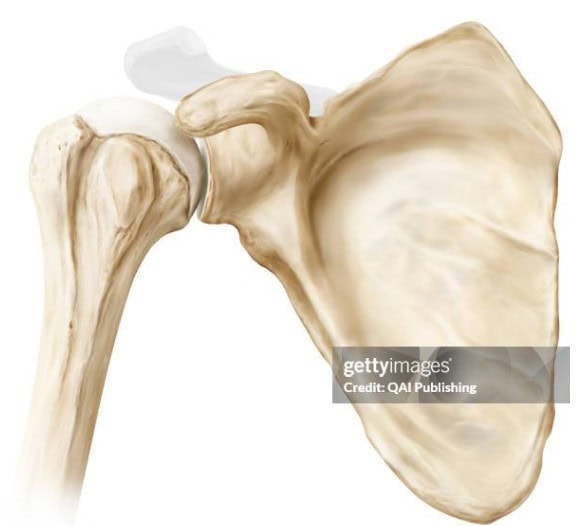
Your labrum is what I like to call your soft socket, it is a layer of cartilage that extends from the socket. Your labrum deepens your socket, making it a better home for the ball whilst maintaining your movement because it is flexible. Your ligaments attach 360 degrees around the ball and socket, providing a wall of support in every direction. Then overlying this, you have your Rotator cuff.
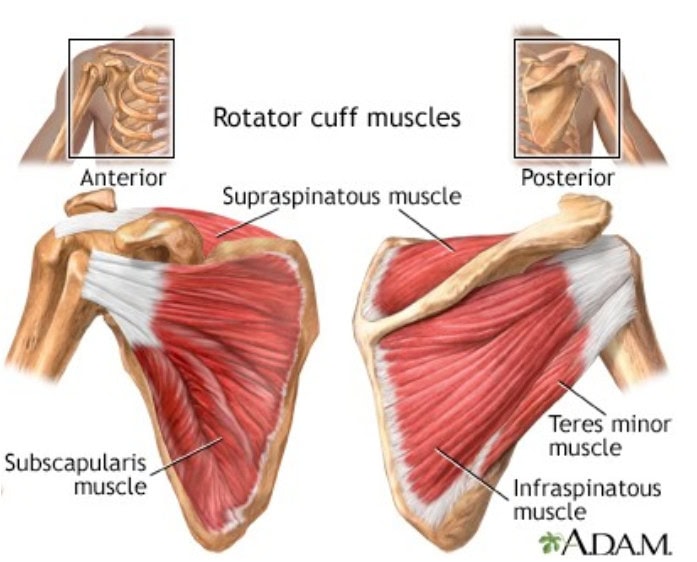
Your Rotator Cuff is actually a group of muscles, I like to think of “Rotator Cuff” as a team name for the 4 muscles (Supraspinatus, Infraspinatus, Teres Minor, Subscapularis) that dynamically stabilise the joint. The muscles attach front and back on your scapula (shoulder blade) and wrap around/attach to the front and back of the humeral head (the ball) (Figure 2). They work together as a team to keep the ball centred on the socket as you move your arm in space, or in the gym as you push/pull/lift heavy weights. Your rotator cuff has been referred to as the most important part of the system. The reason is that shoulders have shown the capacity to cope with suboptimal joint anatomy and ligament or labral damage IF the rotator cuff is strong and able to keep the joint centred as you live life. And the same is not true when the roles are reversed. If your passive structures (joint shape and ligaments) are healthy, but you have a very weak and uncoordinated rotator cuff, your risk of shoulder pain is high. Therefore the big take home is that rotator cuff strength and coordination matters. Your shoulder is resilient, joints that are painful and even those that have withheld some trauma have the capacity to function well with minimal pain when the rotator cuff is doing its job.
What is happening in the gym?
Now that we understand how the shoulder works, let’s talk about what is happening in the gym. Shoulder pain in the gym can be caused by a number of things: poor technique, hypermobility, increasing your weights too quickly or when the weight through the shoulder starts getting properly heavy. Stick with me, I am NOT saying heavy lifting is bad, just that if you’re getting shoulder pain there are probably some tricks that can help. With all of the mechanisms I’ve described above, the underlying issue is the same. The shoulder is sliding on the joint and the rotator cuff needs to do a better job at keeping it centred.
How do we help?
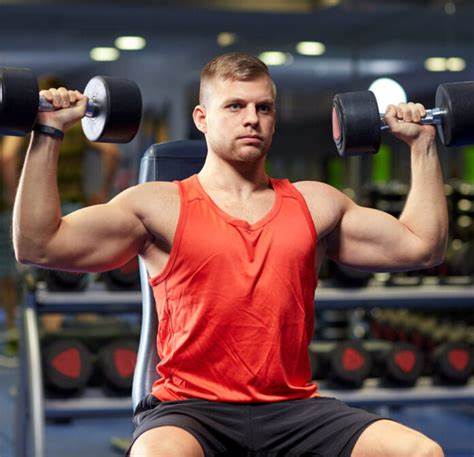
In the case of people with poor technique, they have learnt to stabilise the shoulder by letting the ball sit forwards in the joint. They rely on the anterior labrum and ligaments as their point of fixation rather than using the rotator cuff to lock the joint into its centred position. Typically, this presents as a locking down through the pecs and a failure to extend through the chest so that the shoulders appear rounded at the front (Figure 3). The solution is largely education around proper setting of the shoulders and addressing rotator cuff weakness if this is a feature of why the poor technique exists in the first place.
Hypermobility is a structural underlying cause to excessive glide on the joint. This can be due to shallow formation of the bony socket or highly flexible soft tissue – all of which are genetic and unchangeable. Hypermobility can also be present due to traumatic injuries such as a shoulder dislocation. In all of these cases, the issue is that the passive structures (bone shape, labrum and ligaments) create slack in the system, making it easier for the ball to slide around on the socket. Interestingly, rather than avoid exercise, working to make the shoulder as strong as possible has been shown to be the best solution. The shoulder is beautifully able to compensate for the slack in the joint when there is stiffness in the muscles. Often this means building strength in both the rotator cuff and your power muscles throughout your upper body.
Finally, slide and glide on the joint can occur when you increase your weights too quickly or in heavy powerlifting moves. Even though the individual in both of these examples likely vary dramatically in physique, the underlying issue is the same. In both, the rate at which the power muscles of your shoulder strengthen, outweighs the strength of your rotator cuff. Particularly if training doesn’t involve targeted rotator cuff training. As the bigger muscles get stronger the disparity in strength widens and the rotator cuff increasingly fails at centering the joint as it produces enough force to lift heavy. Typically this issue can be corrected quickly by adding rotator cuff exercises as an adjunct to your upper body days at the gym.
What now?
Hopefully this has shed some light on the niggly gym shoulder and given you some direction on how you might tweak your training to resolve that grumbly shoulder issue. However, if you continue to have concerns, checking in with your physio for a proper assessment and guidance is always a good idea!
Figure 1: https://sl.bing.net/ccRmx3LuqzI
Figure 2: https://sl.bing.net/hIYVT8KbtD2
Figure 3: https://sl.bing.net/frJJbZKiFUa